
Wet-bulb temperature is a crucial value for fruit growers, especially when assessing frost danger in early spring. Unlike ordinary air temperature – also called dry-bulb temperature – wet-bulb temperature takes account of the amount of moisture in the air. The drier the air, the more water can evaporate and the lower the wet-bulb temperature becomes.
Calculate the wet-bulb temperature
Enter the air temperature and relative humidity. The calculator uses a psychrometric calculation (more accurate than the Stull formula) and also gives the dew point.
Disclaimer: the result of this calculator is a calculated indication based on the values you enter. It is not advice, and no rights can be derived from the result. Always base decisions on frost protection or crop treatment on a wet-bulb temperature measured at crop height and on your own professional judgement. FieldGuard accepts no liability for any loss or damage arising from the use of this calculator or from decisions based on its result.
How the calculator works, and why this method
- Saturation vapour pressure. For the air temperature T (°C), the calculator uses the Magnus formula: es(T) = 6.112 × exp(17.62 × T / (243.12 + T)) hPa. These constants are given in the WMO guide to meteorological measurements (WMO-No. 8).
- Actual vapour pressure. From the relative humidity (RH): e = RH/100 × es(T).
- Wet-bulb temperature. The calculator finds the temperature Tw for which es(Tw) − 0.000662 × p × (T − Tw) = e. This is the psychrometric equation, the physical principle behind a wet-bulb thermometer. 0.000662 is the psychrometric coefficient for a ventilated psychrometer (FAO-56) and p is the air pressure in hPa (default 1013.25). The equation is solved step by step (bisection, 60 steps), so the numerical error is negligible.
- Dew point. From the inverted Magnus formula: Td = 243.12 × a / (17.62 − a), with a = ln(RH/100) + 17.62 × T / (243.12 + T).
Why this method? The psychrometric equation describes what physically happens at a wet bulb and is the basis meteorological services use to derive humidity from psychrometers. Quick rules of thumb, such as Stull (2011), are approximations that can be off by up to about 1 °C. Around freezing point, that is exactly the margin that matters.
Limitations. Below 0 °C the calculator uses vapour pressure over water, not over ice, which gives small differences. The result is only as good as the input: temperature and humidity from a weather station further away can differ from what happens in your field at crop height.
Sources: WMO-No. 8, Guide to Instruments and Methods of Observation (chapter on humidity) · FAO Irrigation and Drainage Paper 56, chapter 3 · Stull (2011), Wet-Bulb Temperature from Relative Humidity and Air Temperature.
What is wet-bulb temperature and what does it mean for your crop?
When water evaporates, it extracts heat from its surroundings. We all know this principle: if you have wet hands in the wind, they feel colder. That is because the water on your skin evaporates and carries heat away. The same effect occurs around a flower bud or young fruit. If the air is dry, more moisture evaporates from the crop, so it cools faster – often to below zero, even if the air is still above freezing. That is what makes wet-bulb temperature so important: it gives a much more realistic picture of when freezing really begins.
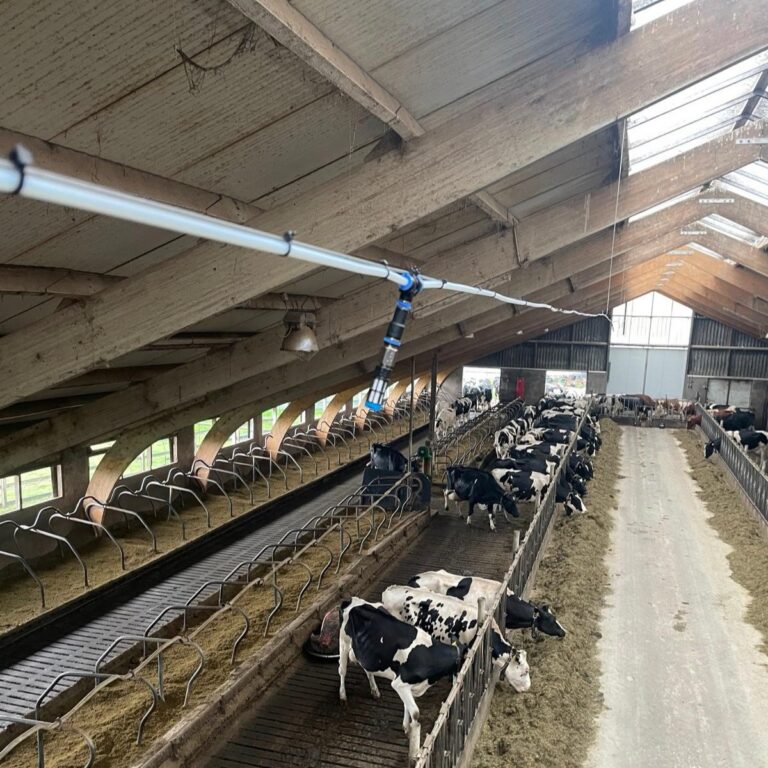
It is not only fruit growers who benefit from tracking wet-bulb temperature. It also plays a role in livestock farming: at high values the risk of heat stress in cows and poultry increases. In glasshouses and horticulture, wet-bulb temperature determines how effectively crops cool through evaporation. For arable farmers, the value helps plan irrigation better during warm, dry periods. So it is an indicator that is valuable in almost every branch of farming.
Measuring wet-bulb temperature with a wet-bulb thermometer
To measure wet-bulb temperature, you use a wet-bulb temperature meter or wet-bulb thermometer. This consists of a temperature-sensitive sensor wrapped in a wet cotton wick. The wick is kept moist constantly – in some systems even automatically. As the water evaporates, the sensor cools. The temperature you then measure is the wet-bulb temperature.
The rate of evaporation – and therefore the cooling – depends on humidity. At high humidity less water evaporates, and the wet-bulb temperature is closer to the dry-bulb temperature. At low humidity the difference is greater, and so is the risk of the crop freezing.
What does the difference between wet-bulb and dry-bulb temperature tell you?
The difference between the dry-bulb temperature and the wet-bulb temperature tells you something about humidity. The bigger the difference, the drier the air. This difference determines evaporation from the crop. In situations with high humidity (such as fog), the two temperatures are close together. But on a clear, dry night the wet-bulb temperature can be many degrees lower than the air temperature. That is exactly when the risk of blossom damage is high.
Why is a wet-bulb thermometer important for fruit growers?
A standard thermometer does not tell you when to start irrigating. It only shows how cold the air is, but says nothing about what is happening to your crop. With a wet-bulb temperature meter you can predict much more precisely when the crop drops below freezing. It is therefore no exaggeration to say that the right wet-bulb measurement can make the difference between crop loss and successful protection.
Calculating wet-bulb temperature: formula and worked example
Professional weather stations do this automatically. In simpler systems you can carry out the calculation of wet-bulb temperature using psychrometric tables or formulas, based on the dry-bulb temperature and relative humidity. But note: this requires accurate data and good ventilation of the sensors. In practice, an automatic station that measures and compares both values is the most reliable solution.
For the calculation you need the ordinary temperature (dry bulb) and the relative humidity. A widely used approximation is Stull’s formula (2011), which applies at normal sea-level air pressure:
Tw ≈ T × atan(0.151977 × (RH + 8.313659)^(1/2)) + atan(T + RH) – atan(RH – 1.676331) + 0.00391838 × RH^(3/2) × atan(0.023101 × RH) – 4.686035
where T is the air temperature (in °C) and RH the relative humidity (in per cent).
Worked example: at an air temperature of 2 °C and a relative humidity of 60%, an accurate psychrometric calculation gives a wet-bulb temperature of around −0.5 °C. Stull’s formula comes out at about −1.2 °C. That difference shows why you should not rely on an approximation for frost protection: the formula can be up to about 1 °C out, and around freezing point that is exactly the margin that matters. A wet-bulb temperature measured at crop height is more reliable. Also read how to forecast night frost and get timely warnings.
Rather not calculate it yourself? Use the calculator at the top of this page.
In practice you do not need to do this yourself. Modern weather stations calculate the wet-bulb temperature automatically from the measured values. Above all, the formula shows that wet-bulb temperature always depends on both temperature and humidity.
What is the difference between wet-bulb temperature and dew point?
Although wet-bulb temperature and dew point are both related to moisture in the air, they are two different concepts with a different physical principle and a different purpose in practice. Wet-bulb temperature is sometimes confused with “feels-like” temperature. They are not the same. Feels-like temperature describes how warm or cold it feels to people, for example in wind or high humidity. You can find more explanation about this at the KNMI (the Dutch national weather service).
The dew point: when air becomes saturated
The dew point is the temperature at which the air becomes exactly saturated with water vapour, in other words 100% relative humidity. If the air cools further than that point, water vapour condenses into visible droplets – such as dew on grass or hoar frost on blossom. The dew point is therefore directly linked to condensation and the formation of precipitation.
Wet-bulb temperature: when evaporation stops
The wet-bulb temperature, on the other hand, is the lowest temperature that can be reached when water evaporates from a wet surface into the air. Heat is extracted from the surroundings, cooling a sensor or a flower bud, for example. The drier the air, the lower the wet-bulb temperature.
The differences in practice
| Characteristic | Wet-bulb temperature | Dew point |
|---|---|---|
| Measuring method | Evaporation from a wet wick | Derived from humidity |
| Based on | Evaporative cooling | Condensation |
| Always lower than air temperature | Yes | Yes |
| Always higher than dew point | Yes | No |
| Relevance in fruit growing | Frost risk, evaporation from the crop | Chance of dew or hoar frost |
For practical purposes, there are a few clear signals:
-
Just above 0 °C: start irrigating in good time in fruit growing.
-
Above 28 °C: increased risk of heat stress in livestock.
-
Difference between dry bulb and wet bulb greater than 10 °C: extremely dry air, strong evaporation.
As an aside: worldwide, wet-bulb temperature is also used to interpret heat extremes. At values above 35 °C, the human and animal body can no longer cool down. This does not occur in the Netherlands, but it shows how fundamental this measure is.
Why is this important for fruit growers?
A standard thermometer does not tell you when to start irrigating. It only shows how cold the air is – the so-called dry-bulb temperature – but says nothing about what is really happening to your crop. And that is exactly where the risk lies: blossom can freeze while the thermometer still shows well above zero.
In reality, the temperature of a flower bud is influenced by evaporation. If the air is dry, more moisture evaporates from the crop. That evaporation extracts heat from the bud itself, so it cools faster than the surrounding air. As a result, the crop temperature can fall below zero even before the air temperature does. We call this latent cooling – and it is an important cause of blossom damage from night frost.
A wet-bulb thermometer or wet-bulb temperature meter simulates this evaporation process. By letting water evaporate around the sensor, it mimics what happens to your crop. The temperature the sensor records is therefore much closer to the actual temperature of the flower bud or young fruit. When your crop temperature drops to or below 0 °C, it is time for action – and only the wet-bulb temperature tells you when that happens.
An automated weather station that measures wet-bulb temperature is therefore not a luxury but a crucial investment. It gives an accurate alarm based on crop response – not just air conditions. By intervening early and in a targeted way, you prevent damage and minimise the use of water or other frost measures.
In short: the difference between an ordinary thermometer and a wet-bulb temperature meter is the difference between knowing how cold it is and understanding when your crop is in danger. And that difference can decide your harvest.
Frequently asked questions about wet-bulb temperature
-
Is wet-bulb temperature the same as feels-like temperature?
No. Feels-like temperature is about how warm or cold people experience it. Wet-bulb temperature is about evaporation and the cooling of air and crop. -
How is wet-bulb temperature calculated?
From temperature and humidity. A weather station does this automatically with sensors and a formula. -
What is the difference between wet-bulb temperature and WBGT?
The WBGT index uses wet-bulb temperature, but also takes solar radiation and wind into account. That value is mainly used to determine heat stress in people.