
Soil moisture sensors for continuous moisture monitoring
Water is life, and nowhere is that more true than in the soil we rely on for food, nature and livelihoods.
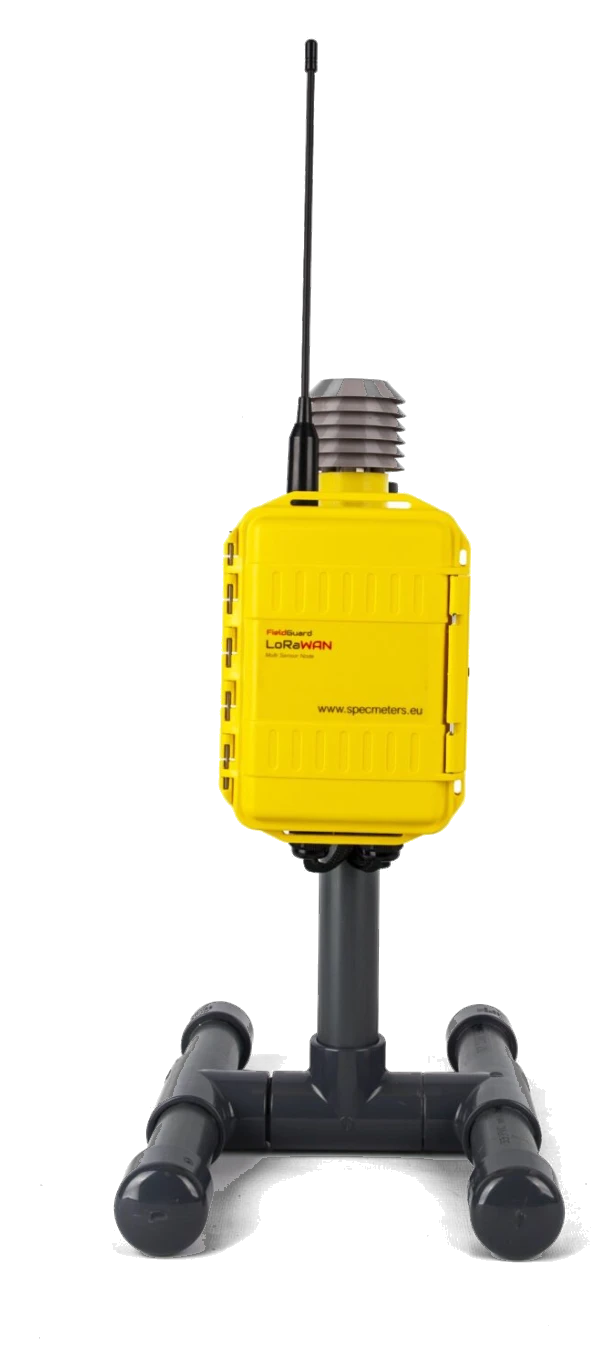
Yet it remains a challenge to know how much water is really available to plant roots, especially when climate and soil conditions are changeable. This is where the soil moisture sensor comes in: a versatile instrument that makes an invisible world visible. In this article you will discover how soil moisture sensors work, which types there are, why they are becoming increasingly important for sustainable management, and which scientific principles underlie them. Whether you are a fruit grower, winegrower, soil researcher or landscape manager – insight into soil moisture is essential for making well-considered decisions.
What is a soil moisture sensor?
A soil moisture sensor (also known as a soil moisture meter or soil humidity sensor ) is a measuring instrument that determines the water content of the soil. Essentially, it indicates how much water is available to plants, which is crucial for the growth, yield and health of vegetation.
There are roughly two approaches:
- VWC (Volumetric Water Content): expresses how many millilitres of water there are per 100 millilitres of soil.
- SWP (Soil Water Potential): measures the suction plants must exert to take up water from the soil.
Both give a different perspective: VWC shows “how much” water there is, while SWP reveals “how difficult” it is to take up that water.
Soil moisture sensor in a fixed monitoring station
A FieldGuard soil moisture sensor is not a handheld meter, but a fixed soil moisture sensor (also called a soil sensor) that stays in the ground all season. The sensors can measure at several depths in the root zone and automatically send their readings to TRACIS. There you follow the trend per field and set your own thresholds for critical soil moisture. You can read more background in soil sensor: explanation and benefits and what dry soil means for your crop. Would you also like to know how high the groundwater is? Then read measuring groundwater levels.

FieldGuard vs standard soil moisture meters
| Feature | Standard soil moisture meter | FieldGuard soil moisture sensor |
|---|---|---|
| Manual measuring | ✖ | |
| Continuous monitoring | ✖ | |
| Near real-time insight | ✖ | |
| Suitable for agriculture | Limited | |
| Software & dashboard | ✖ | |
| Saving water & time | Limited |
Soil moisture measuring principles
Resistance (impedance)
Measuring how well current flows through the soil
With this method, a soil sensor measures the electrical resistance between two electrodes in the soil. Water conducts electricity better than dry soil, so the moister the soil, the lower the resistance. The sensor therefore gives an indirect indication of the moisture content: dry soil = high resistance; wet soil = low resistance.
- Advantageinexpensive and simple in design.
- Limitationvery sensitive to temperature and salts (such as fertilisers), which affect conductivity. Therefore less suitable for accurate or long-term measurements in soils with varying chemical composition.
Capacitive measurement (dielectric method)
Measuring how the soil ‘charges’
This technique uses the difference in dielectric constant between dry soil and water. The soil sensor acts as a kind of capacitor: it generates an electric field between two plates and measures how much “electrical charge” the soil between those plates can hold. Water has a much greater capacity to influence that field than dry soil.
- Advantagefaster and more accurate measurements than resistance sensors, and relatively less sensitive to salt.
- Limitationthe sensors must be properly calibrated for specific soil types to be accurate.
TDR (Time-Domain Reflectometry)
Measuring how long an electrical signal takes
TDR sensors send a short electrical pulse through a conductive rod or cable in the soil. The signal travels through the soil and is partly reflected. By measuring how long it takes for the signal to return, the soil sensor calculates the dielectric properties of the soil and thus the moisture content.
- Advantagevery accurate and stable, insensitive to salts or other interference. Widely used in research or long-term monitoring.
- Limitationmore expensive and complex to use than other methods. Requires special reading equipment.
FDR (Frequency-Domain Reflectometry)
Measuring how frequencies respond to moisture
Instead of measuring a pulse (as with TDR), an FDR sensor sends a series of alternating frequencies through the soil and measures how the electric field responds. Each frequency responds differently to moisture and structure. The sensor analyses the response to determine the moisture content.
- Advantagewell suited for continuous measurements, easy to integrate into automatic systems.
- Limitationsomewhat more sensitive to temperature and electrical interference than TDR. Accuracy depends strongly on calibration.
Soil water tension (tensiometric)
Measuring how much effort a plant has to make to take up water
Tensiometers do not measure how much water there is, but how ‘tightly’ that water is held in the soil. They use a tube filled with water and a porous ceramic tip. As the soil dries, it draws water out of the tube. The resulting suction is measured, usually in kilopascals (kPa). This value says something about the availability of water to plant roots.
- Advantagedirectly measures the stress plants experience, very suitable for crop monitoring.
- Limitationless suitable for extremely dry soils, and slow to respond when conditions change quickly.
Benefits and limitations of soil moisture sensors
Using soil moisture sensors offers clear benefits in a wide range of sectors, from agriculture to ecological research. At the same time, it is important to understand the limitations inherent in the technology or the application context. Below you will find a broad overview of both sides of the story.

Benefits
- Optimising water use Soil moisture sensors help you use water in a targeted way. By knowing exactly how much moisture is in the soil, irrigation can be matched to the actual needs of plants or vegetation. This leads to more efficient water use, prevents waste and contributes to sustainability – an increasingly important goal in times of water scarcity.
- Insight into soil dynamics Sensors offer a rare window into a normally invisible world: the soil. By collecting measurements over longer periods, users gain insight into moisture fluctuations, evaporation, rainfall uptake and the influence of soil texture. This makes it possible to better understand and model processes such as drying out, saturation or water movement.
- Supporting decision systems For organisations that depend on data-driven decision-making – such as farms, governments or research institutes – soil moisture sensors provide reliable input. Think of real-time data for irrigation planning, risk analysis for drought stress, or feedback in soil hydrological models.
- Preventing plant stress and disease pressure By intervening in time when drought increases or, conversely, when the soil becomes waterlogged, diseases such as root rot can be prevented. A balanced soil moisture content directly contributes to plant resilience and physiological health.
- Sustainability and environmental protection Precise irrigation reduces the risk of nutrients or pesticides leaching into the groundwater. In this way, soil moisture measurements indirectly contribute to environmental protection and the preservation of soil quality.
No standard package, but advice that fits
Soil is never the same everywhere. It differs per field, per soil layer, per crop. That is why we do not supply an off-the-shelf soil moisture station. We first look at what makes sense in your situation.
Sometimes one soil moisture sensor is enough to get a grip on water availability. Sometimes several sensors at different depths are needed to properly understand root activity and capillary action. In other cases, a complete soil moisture station with several measuring points is the only way to make reliable decisions.

We match the number of sensors, the measuring depth and the placement to your crop and goal. No over-sizing. No sensors that add nothing.
We also say no if something adds no value. That is part of it.
Request advice or a quote
Would you like to know what a soil moisture station or soil moisture sensor would mean for your fields? Get in touch. No sales pitch. No assumptions. Just a straightforward conversation.
You get:
- Honest advice
- A clear quote
- A solution that works in practice
Request advice or a quote. Then you know where you stand and can manage based on facts instead of gut feeling.
Tailored quote
Request a no-obligation quote or demo. We will get in touch as soon as possible and are happy to think along with you.
- info@fieldguard.net
- +31 543 472 334
- Vierde Broekdijk 1, 7122 JD Aalten
Request a quote
Leave your details and we will get in touch.
